
 Contact Us
 My Account
 Basket


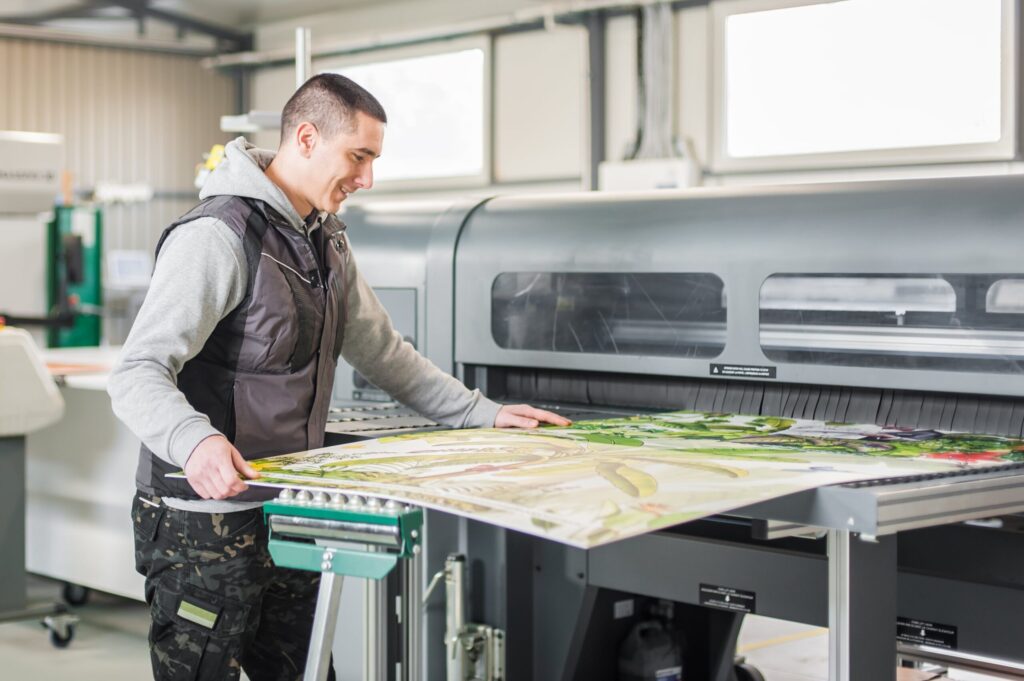
The printing press is one of the most significant inventions in human history. It revolutionised communication, education, and information sharing. Before the printing press, books were handwritten, making them expensive and time-consuming to produce. The invention of movable type printing changed everything, allowing books, newspapers, and printed materials to be mass-produced.
But now you may ask, when was the first printing press invented, and how did it shape modern printing?
Well, let’s quickly find out where it originated from, its functions, and its evolution into the 3D printing era.
Who is The Inventor of The Printing Press?
The printing press was invented in the mid-15th century by Johannes Gutenberg, a German inventor. His groundbreaking technology allowed books to be printed efficiently, making them widely available for the first time in history.
Who Invented Printer Machine?
Gutenberg invented the printing press in Mainz, Germany, around 1440. His movable-type system was far more efficient than traditional block printing, which had been used in China centuries earlier.
This invention marked the beginning of the Printing Revolution, significantly impacting education, literacy, and the spread of knowledge.
The First Printed Book Ever!
Gutenberg’s most famous work is the Gutenberg Bible, printed around 1455. It was one of the first major books to be mass-produced, setting the foundation for modern printing.
Who Invented the Printer Machine?
While Gutenberg pioneered the printing press, the evolution of printing continued.
- Mechanical Printer (1822):
- Invented by Charles Babbage, this early concept of a printer was designed for computational use but never fully developed.
- Xerographic Printer (1938):
- Developed by Chester Carlson, this dry-printing technique became the basis for modern photocopying.
- Laser Printer (1969):
- Created by Gary Starkweather, this innovation brought high-speed digital printing to offices and homes.
- Inkjet Printer (1976):
- First introduced by Canon and Hewlett-Packard, making colour printing more accessible.
Here’s a Quick Look Into Different Printing Technologies:
| Printing Method | Year Invented | Key Features |
| Printing Press | 1440 | Movable type, manual press |
| Mechanical Printer | 1822 | Early computational printing |
| Xerographic Printer | 1938 | Dry toner, used in photocopiers |
| Laser Printer | 1969 | High-speed, precise printing |
| Inkjet Printer | 1976 | Affordable, colour printing |
| 3D Printing | 1984 | Creates 3D objects layer by layer |
As technology advances, foamex board printing and other printing techniques will further evolve, offering new possibilities for design, marketing, and manufacturing.
How Did the Printing Press Work?
Today, whether you’re working with traditional printing techniques, or modern materials like acrylic, dibond signs, or PVC signs, understanding how they work is essential. The printing press functioned using a combination of movable metal type, ink, and a screw mechanism. The process involved:
- Arranging Movable Type: Individual letters were arranged on a flat surface.
- Applying Ink: Ink was spread over the raised letters.
- Pressing Paper: A sheet of paper was pressed onto the inked type.
- Creating Multiple Copies: The process was repeated for multiple prints.
This method was far quicker and more efficient than hand-copying, allowing books to be produced at a much lower cost. Similarly, the development of 3D printing continues to redefine industries, from medicine to construction.
Impact of the Printing Press on Society
- Increased Literacy: More people could afford books, leading to higher literacy rates.
- Religious Reformation: Enabled the spread of Martin Luther’s 95 Theses, challenging the Catholic Church.
- Scientific Advancements: Allowed researchers to share findings more efficiently.
Did you know, according to the data from Printing Press, it was found that by 1500, over 20 million books had been printed across the entire Europe? The journey from Gutenberg’s press to digital and 3D printing showcases the incredible potential of human innovation.
When Was the First 3D Printer Invented?
The first 3D printer was invented in 1984 by Chuck Hull, an American engineer. He developed stereolithography (SLA), a technique that uses liquid resin hardened by ultraviolet light to create three-dimensional objects.
3D Printer – when 3d printer invented?
While Hull’s SLA method was the first 3D printing process, other technologies followed:
- 1988: The first Selective Laser Sintering (SLS) printer was developed.
- 1992: First Fused Deposition Modeling (FDM) printer released.
- 2000s: 3D printing expanded into medicine, manufacturing, and construction.
Today, 3D printing is used for everything from prosthetics to building houses.
Growth of 3D Printing Market:
The 3d printing market in the UK is expected to reach a projected revenue of US$ 6,699.4 million by 2030. A compound annual growth rate of 23.4% is expected of UK 3d printing market from 2024 to 2030.
Final Thoughts
From Gutenberg’s printing press to modern 3D printers, the evolution of printing technology has shaped how we share information. The journey is truly mind-blowing on how a small idea has taken over the way we see and read things!
The ability to mass-produce books and materials led to increased literacy, scientific advancements, and widespread knowledge sharing.
Are you in search of high-quality printed materials? At VC Print, we offer premium printing solutions, from traditional prints to modern signage like Foamex and Dibond boards. Experience top-notch printing with us today!


